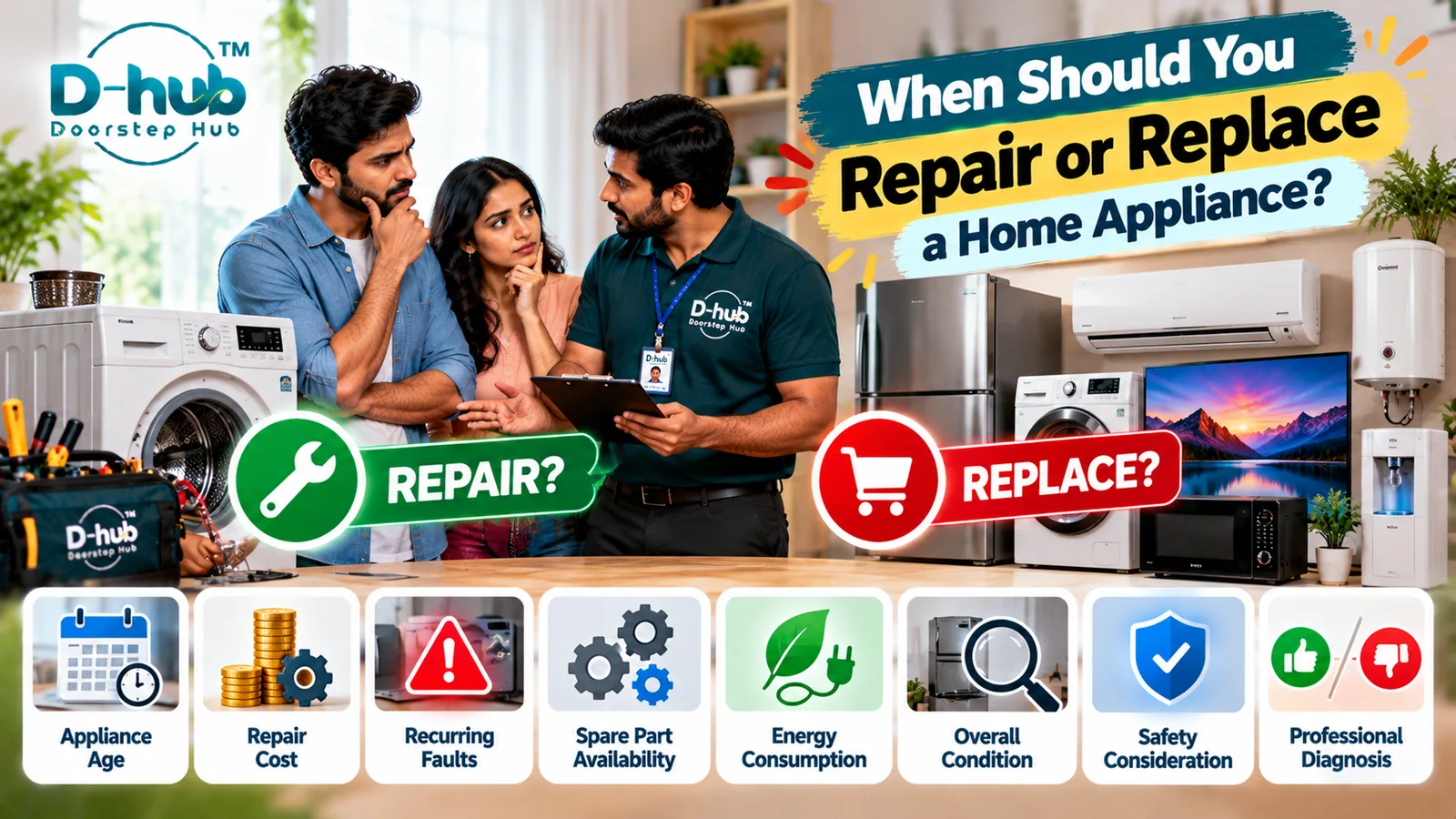
When a home appliance develops a problem, one of the first questions is whether it makes more sense to repair the appliance or replace it with a new one. There is no single answer that applies to every refrigerator, washing machine, air conditioner, microwave, television, water purifier, geyser, or other household appliance. The right decision can depend on the age of the appliance, type and severity of the fault, estimated repair cost, frequency of previous breakdowns, spare-part availability, energy consumption, safety, and overall condition. A relatively new appliance with a minor repairable fault may continue working effectively after professional servicing, while an older appliance experiencing repeated major failures may eventually become less practical to repair.
Before making a decision, it is useful to understand the actual fault rather than replacing an appliance simply because it has stopped working. Doorstep Hub brings you this practical guide to help you evaluate the most important factors when comparing appliance repair and replacement, understand when professional diagnosis can help, and make a more informed decision based on the appliance's condition and expected future use.
Why Is the Repair-or-Replace Decision Important?
Home appliances can represent a significant household investment. Replacing an appliance unnecessarily can create additional expense, while repeatedly repairing an appliance in poor condition may also become costly.
Before deciding, consider:
- Appliance age
- Type of fault
- Estimated repair cost
- Previous repair history
- Frequency of breakdowns
- Spare-part availability
- Energy consumption
- Overall physical condition
- Safety concerns
- Expected remaining useful life
A professional diagnostic inspection can provide useful information about the actual problem before you decide.
1. Consider the Age of the Appliance
Age is an important factor, but it should not be considered alone.
A relatively new appliance with a repairable component problem may still have considerable usable life remaining.
For example, a fault involving a replaceable component does not necessarily mean the entire appliance needs replacement.
For an older appliance, consider age together with its repair history, condition, efficiency, and availability of replacement parts.
2. Understand the Actual Fault
Avoid deciding to replace an appliance before understanding what has failed.
A problem that appears serious may sometimes have a relatively straightforward cause.
Depending on the appliance, faults may involve:
- Electrical components
- Sensors
- Motors
- Control boards
- Fans
- Pumps
- Heating components
- Cooling components
- Switches
- Internal connections
A proper diagnosis can help determine the affected component and whether repair is practical.
3. Compare Repair Cost With Replacement Cost
Ask for an estimate after the appliance has been diagnosed.
Consider the repair cost alongside:
- Current appliance condition
- Cost of an appropriate replacement
- Age of the existing appliance
- Previous repair expenses
- Likelihood of additional problems
- Parts availability
A lower repair cost may make repairing a relatively new appliance reasonable, while a major repair on an older appliance with multiple existing problems may require closer consideration.
4. Consider How Often the Appliance Breaks Down
Repair history can provide useful information.
If the appliance has generally been reliable and develops its first significant fault, repairing it may be worth considering after diagnosis.
However, repeated failures involving different components may indicate that the appliance's overall condition is deteriorating.
Keep records of previous repairs where possible so you can compare:
- Number of repairs
- Types of faults
- Cost of previous repairs
- Time between breakdowns
This provides a clearer picture than evaluating only the latest problem.
5. Check Spare-Part Availability
Repair may become difficult when compatible replacement parts are no longer readily available.
This can be particularly relevant for:
- Older appliance models
- Discontinued products
- Imported models
- Appliances using model-specific electronic components
Before proceeding with a major repair, confirm whether the required component is available and appropriate for your appliance model.
6. Consider Energy Consumption
Older appliances may sometimes consume more electricity than newer models, although actual consumption varies considerably by appliance type, model, condition, usage, and technology.
If you are comparing a major repair with replacement, consider the appliance's current energy performance.
Check:
- Manufacturer specifications
- Applicable energy-efficiency information
- Actual household usage
- Condition of the appliance
Do not assume that replacement will automatically produce enough energy savings to justify the purchase. Compare the relevant models and operating costs.
7. Evaluate the Overall Condition
Look beyond the immediate fault.
Consider whether the appliance also has:
- Significant rust or corrosion
- Physical damage
- Damaged electrical connections
- Repeated unusual noises
- Water leakage
- Excessive overheating
- Multiple failing components
- Poor overall performance
An appliance with one isolated fault is different from an appliance experiencing several age-related problems simultaneously.
8. Consider Safety Before Cost
Safety-related problems deserve particular attention.
Stop using an appliance and arrange appropriate inspection if you notice:
- Burning smell
- Smoke
- Sparking
- Electric shock or tingling
- Melted wiring or plugs
- Serious overheating
- Significant water leakage near electrical components
- Other visible electrical damage
Do not continue operating an unsafe appliance simply to postpone repair or replacement.
9. Think About Future Reliability
Repairing one component does not guarantee that an older appliance will never develop another fault.
At the same time, one component failure does not necessarily mean that the entire appliance is unreliable.
Consider the complete history:
Repair may be worth considering when:
- The appliance is relatively new.
- The fault is isolated.
- Repair cost is reasonable.
- Compatible parts are available.
- The appliance has otherwise been reliable.
- Overall condition remains good.
Replacement may be worth considering when:
- The appliance is significantly aged.
- Major failures occur repeatedly.
- Several components are deteriorating.
- Required parts are difficult to obtain.
- Repair costs have accumulated substantially.
- There are unresolved safety concerns.
The final decision depends on the individual appliance and circumstances.
10. Get a Diagnostic Inspection Before Deciding
When the cause of the problem is unclear, professional diagnosis can help you make a more informed decision.
A technician may be able to identify:
- The faulty component
- Extent of the problem
- Whether additional damage is present
- Parts required
- Estimated repair requirements
- General condition of the appliance
You can then compare this information with replacement cost, age, repair history, and expected future use.
Which Home Appliances Can Be Evaluated?
The same general repair-versus-replacement approach can be useful for many household appliances, including:
- Air conditioners
- Refrigerators
- Washing machines
- Microwave ovens
- LED and Smart TVs
- Geysers
- Water purifiers
- Laptops and computers
- Other household electrical appliances
The specific repair economics and expected lifespan vary by appliance, model, usage, and condition.
When Should You Call an Appliance Technician?
Consider professional diagnosis when:
- You cannot identify the fault safely
- The appliance repeatedly breaks down
- A major component may have failed
- You need an accurate repair estimate
- Spare-part compatibility needs to be checked
- Electrical or internal repairs are required
- The appliance has safety-related symptoms
- You are uncertain whether repair is economically practical
A diagnosis gives you more useful information before committing to either repair or replacement.
Home Appliance Repair Support with Doorstep Hub
If you are unsure whether your home appliance should be repaired or replaced, Doorstep Hub can help you connect with service professionals for appliance inspection, troubleshooting, maintenance, and repair assistance.
Whether you have a problem with an air conditioner, refrigerator, washing machine, microwave, television, water purifier, geyser, laptop, computer, or another supported appliance, identifying the actual fault first can help you compare repair requirements with the appliance's age, condition, reliability, and replacement cost.
Need Home Appliance Service Support?
📞 Helpline: 8886688666
🌐 Website: doorstephub.com
📲 Doorstep Hub App: Open Doorstep Hub App
Before replacing an appliance because of a single fault, understand what has actually failed. Likewise, if an older appliance is experiencing repeated expensive problems, consider its complete repair history and overall condition before investing further.
Frequently Asked Questions
Common troubleshooting questions answered by our specialists
Was this article helpful?
Your feedback helps us improve our repair guides and service tips.